
From 28 August 2026, the tourist train named “Hue Ancient Capital – Phong Nha: Journey of Wonders – World Heritage” is scheduled to begin service, linking two of central Vietnam’s greatest heritage regions in a single morning. This is a rail tourism product jointly developed by the People’s Committee of Quang Tri Province, the People’s Committee of Hue City and Vietnam Railways Corporation – not simply another passenger service.
On 31 July 2026, the three parties held a product development workshop and signed a Memorandum of Understanding for the 2026–2030 period, with the goal of building an inter-regional tourism route based on green and sustainable development. For travellers, the most notable point is this: for the first time, the journey from Hue Ancient Capital to Phong Nha – Ke Bang has an all-in-one product running on rails, where the act of travelling is itself part of the trip.
Eight carriages, 304 seats and those 360-degree rotating seats
The most intriguing feature of this train lies in its interior layout. The full set comprises 8 carriages with a capacity of around 304 passengers, divided into four clearly distinct functional groups:
- 5 soft-seat carriages with 360-degree rotating seats – 56 seats each. The seats rotate freely, meaning passengers choose their own orientation: facing the window for the scenery, facing each other for group conversation, or facing the direction of travel.
- 1 VIP carriage with 24 seats – a private space with a far lower seat density, for travellers seeking a premium experience.
- 1 community carriage – a shared area for socialising and group activities.
- 1 service and entertainment carriage – hosting food and beverage, art performances and onboard services.
This layout reveals a shift in product thinking: the train is not designed to “move people from A to B”, but to keep passengers engaged for more than four hours without boredom. The carriages apply technology to commentary and communication, and the interiors carry the cultural and heritage identity of Hue and Quang Tri.
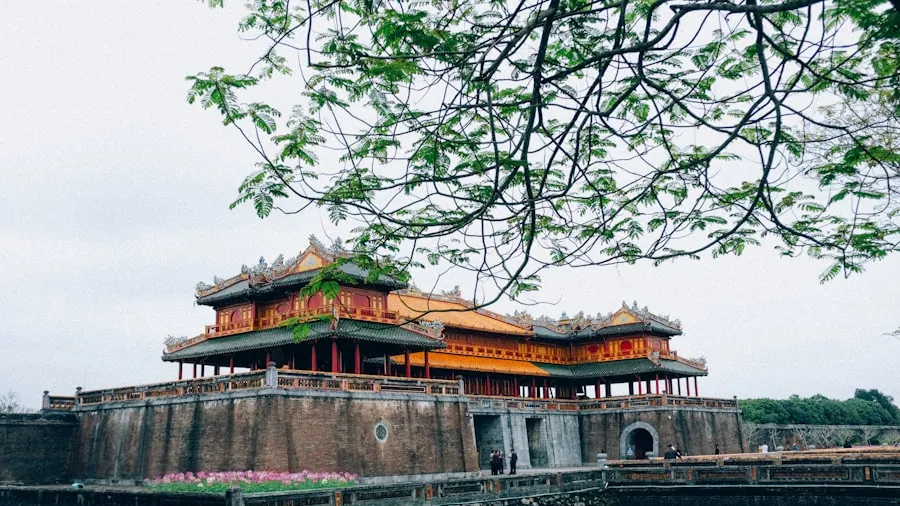
HQ1 – HQ2 timetable and the five stations
The pair of trains is numbered HQ1 and HQ2, running same-day services in both directions:
- HQ2 (northbound): departs Hue station at 07:15, arrives at Tho Loc station at 11:55.
- HQ1 (southbound): leaves Tho Loc station at 13:15, returns to Hue station at 17:25.
The journey covers approximately 190 km, passing through the stations of Hue – Dong Ha – My Trach – Dong Hoi – Tho Loc. Each station is oriented around its own theme, ranging from cultural heritage to nature tourism; at the stops there are photo areas, local product showcases and visitor services.
This timetable is notable because it makes a same-day return trip possible. Travellers staying in Hue can take HQ2 in the morning, spend about an hour around Phong Nha and return on HQ1 in the afternoon – though honestly, that is a tight schedule. Those who choose to spend a night near Phong Nha get a full day for the caves, then catch the return train the next day at a relaxed pace.
190 km across two heritage regions: what is worth the window seat?
The North–South railway heading north from Hue is one of Vietnam’s most pleasant stretches of track: the train runs through the coastal lowlands of central Vietnam, flanked by rice fields, villages and rows of casuarina windbreaks, with the Truong Son range on the distant horizon.
This is also the route through Quang Tri’s historic landscape – once the dividing line between the two halves of the country, today a destination for remembrance and commemorative travel. The closer you get to Dong Hoi, the more the scenery turns coastal: sand dunes, river mouths and the long beaches of the Nhat Le area.
The final station, Tho Loc, is the most convenient gateway into Phong Nha – Ke Bang National Park, a UNESCO World Natural Heritage site famous for one of the planet’s most extensive cave systems. If you take a rotating seat and turn towards the window, there is something to look at for almost the entire journey – which is precisely why those 360-degree seats were put on board.
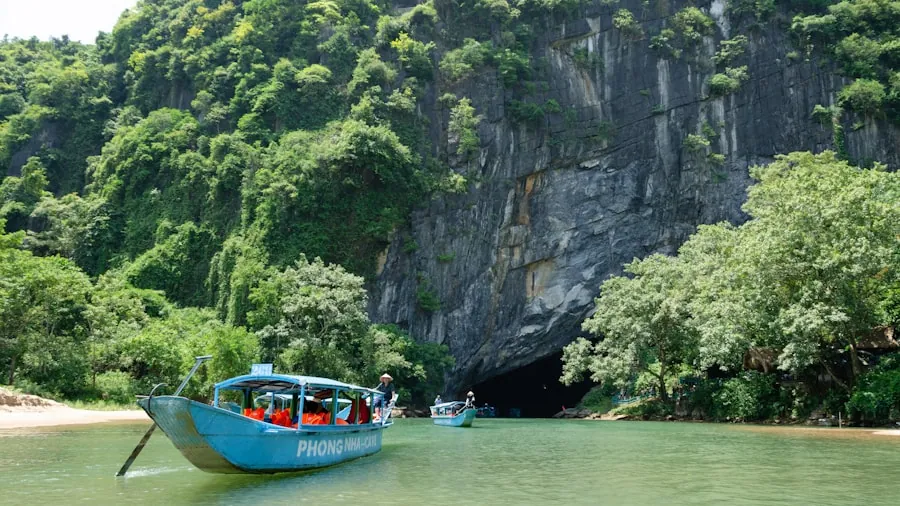
More than transport: cuisine, performance and heritage storytelling
What separates this product from an ordinary train ticket is the “soft” content. Under the plan agreed by the three parties, the train will host dining spaces featuring the signature cuisine of both localities, art performances and cultural exchange, along with entertainment services and events.
For international visitors this is an easy proposition: instead of four hours in a car on the highway, they get to taste Hue and Quang Tri dishes on board, hear commentary about the land they are crossing, watch a short performance, and step off the train already holding the cultural context in mind. For domestic travellers, it is a rare “slow” trip – no traffic jams, no motion sickness, and the freedom to walk between carriages.
The model is not new to Vietnam Railways – the “Connecting Central Heritage” train on the Hue – Da Nang route has proven over recent years that travellers will pay for an experience on rails. What is different this time is the larger scale, the longer route, and a long-term cooperation commitment through 2030 between two localities and the railway sector, rather than a seasonal trial run.
Suggested itineraries
Option 1 – Same-day return (for travellers short on time): HQ2 in the morning from Hue, arrive Tho Loc at 11:55, a quick lunch and a look around the area near the station, then HQ1 at 13:15 back to Hue. Upside: compact, no need to change hotels. Downside: barely enough time to go deep into a cave.
Option 2 – Two days, one night (recommended): Day 1 take HQ2, spend the afternoon at Phong Nha Cave or Paradise Cave, overnight around Phong Nha or Dong Hoi. Day 2 devote the morning to a second cave or the Chay River – Dark Cave experience, then catch HQ1 back to Hue at 13:15.
Option 3 – Combine the central heritage corridor: Da Nang – Hoi An → Hue (2 days) → HQ2 out to Phong Nha (2 days) → back to Hue to fly onward or continue by rail. This is the most sensible plan for international travellers with 7–10 days in Vietnam.
A few things to note before booking
- Ticket prices had not been officially announced at the time of writing. Follow information from Vietnam Railways Corporation and authorised agents rather than price lists circulating on social media.
- Launch date: the most widely cited date is 28 August 2026; some sources mention a possible shift to early September. If you are booking related services such as hotels or station transfers, choose options with a flexible cancellation policy for these first departures.
- Capacity is limited: 304 seats per departure, of which only 24 are VIP. During the summer peak and public holidays, that is not a large number.
- Plan for “after the station”: you still need road transport from Tho Loc station to the attractions. Booking a transfer in advance avoids the scramble when a hundred passengers look for a vehicle at once.
Go365 travels the heritage route with you
As an online travel platform operating across Vietnam, Go365 keeps track of new tourism products so travellers have more options for their journeys:
- Tours and experience tickets at destinations throughout Vietnam, with transparent pricing and booking in a few steps.
- Transfer and road transport services, ideal for continuing your journey after leaving a station or airport.
- Travel eSIM, giving international visitors instant 4G/5G connectivity to check train times, maps and stay in touch throughout the trip.
Bringing the “Hue Ancient Capital – Phong Nha: Journey of Wonders – World Heritage” train into service signals that Vietnamese rail tourism is entering a new phase – one where the train is no longer the means of transport but the destination itself. If you are planning for autumn 2026, this is certainly a name worth putting on the itinerary.
Source: the rail tourism product development workshop held on 31 July 2026 by the People’s Committee of Quang Tri Province, the People’s Committee of Hue City and Vietnam Railways Corporation, as compiled from Vietnamese press reports.
Read more: New Dong Hoi – Cam Ranh air route: Quang Tri and Nha Trang are now just 1 hour 20 minutes apart.